
Welcome.
A word from the founder
The bicycle has often been described as mankind’s most noble invention.
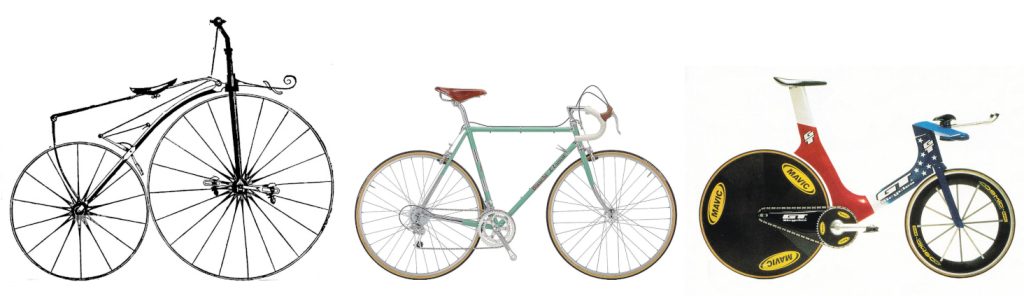
From the earliest velocipedes onwards, bicycle design has always been a story of experimentation. For more than two centuries, people have reimagined its looks, its functionality, and sought out engineering solutions that could make it faster, more efficient, more comfortable or simply better. Ideas came and went; many were refined, many were abandoned, and many didn’t quite live up to the vision of their designers simply because of limitations imposed by the materials and manufacturing techniques available to them. Solid pieces of timber, forged steel parts and later on the familiar forms of joined metal tubes – all brought obvious limits to what could be achieved with them.
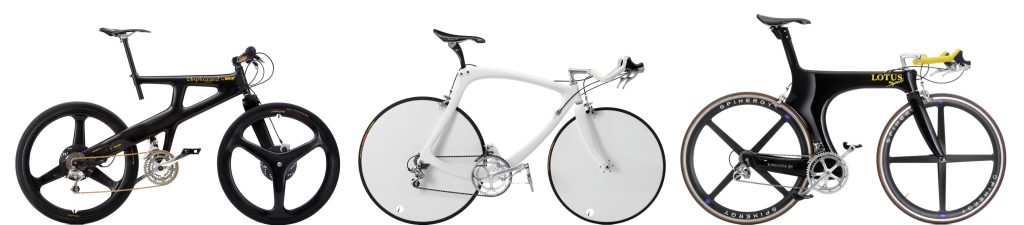
Then, around the middle of the 1980s, many of these limitations fell away. The arrival of Kevlar, carbon fibre and new manufacturing techniques allowed designers and engineers to step outside the box that traditional materials had imposed upon them. They were no longer constrained by what could be done with metal and were suddenly able to sculpt frames and wheels into the most radical shapes imaginable.
Although their goals came from the world of engineering — optimising stiffness, compliance, aerodynamic performance and outright performance in competition — the ability to free-form the design to match those goals actually allowed the humble bicycle to cross into another dimension: that of sculptural, kinetic art.
One of the most remarkable opportunities these new materials created was the possibility of timelessness in design. Engineers and designers were not simply imagining the future; they could draw on many unrealised ideas from the past at the same time. Ideas that had appeared in some of the very earliest bicycles — different-sized wheels, unconventional frame forms, enclosed drivetrains and radically different approaches to the relationship between rider and machine — could suddenly be revisited because these new materials made them possible in ways that earlier designers could only dream about.
Importantly, these were not simply beautiful bicycles. They worked, and they worked well. New world records were set on them. Many Olympic and World Championship medals were won on them. The cycling media and the public raved about the appearance of these extraordinary machines. This interest also changed something quite fundamental in the world of cycling: the athlete had traditionally taken centre stage, but now the bicycle itself became part of the spectacle.
No longer simply the instrument through which the athlete demonstrated his or her ability, it had become worthy of attention in its own right — something people wanted to look at, talk about, photograph and understand.
Then, however, the rules changed.
The UCI, cycling’s world governing body, had become increasingly concerned about the direction in which technological development was taking the sport. The Lugano Charter of 1996 established principles that subsequently became embedded in the UCI’s technical regulations, with the stated intention of ensuring that cycling remained fundamentally a contest between athletes rather than between machines and of preventing technological development from becoming the dominant factor in performance. It sought to preserve the traditional culture and image of the bicycle and to maintain a level playing field.
The consequences were profound. The new rules governing the shape and construction of bicycles effectively excluded all of the radical designs that had emerged during the preceding decade. Designers were forced to put many of their ideas aside as the market for these machines evaporated, and many of the companies that had spent years developing them disappeared.
Imagine if the FAA decided that aeroplanes should once again resemble biplanes. Imagine if regulators decided that architecture could no longer employ novel structural forms, or that civil engineering regulations suddenly stipulated that bridges should once again adhere to designs developed by the Romans two thousand years ago.
We would regard such a decision as extraordinary, and, probably, unacceptable.
Yet something remarkably similar happened to arguably the most exciting period bicycle design had ever seen in over 200 years.
Fortunately, the UCI did not control every form of cycling. Triathlon operated under a different governing structure, and many ideas survived there. But the damage had already been done. Market opportunities nosedived and an entire avenue of experimentation was reduced to fragments.
Not long after, the world itself changed – from paper-based media to the age of the internet. Information on this period of spectacular innovation became scattered, difficult to find and rapidly slipped from public consciousness.
Fans of this period however slowly began to organise. They built online forums, exchanged hard-to-find information, tracked down rare machines and built their own private collections in their garages or attics.
In 2006, the Nuci Bici collection began with a single frame. Over the following twenty years it grew to around 120 bicycles, together with rare components, brochures, documentation and other material relating to this extraordinary period in bicycle design.
In 2019, the idea was born to make the collection publicly accessible through a museum. The objective was to create a space for people to once again see these machines, marvel at them and understand the ideas that went into creating them. And, most importantly, so that they might inspire children and young people to imagine a different future.
Because ultimately, Nuci Bici is not really about old bicycles;
It is about human imagination.
It is about what happens when designers are willing to step outside convention, when engineers refuse to accept that something cannot be done, and when new materials allow an idea that once seemed impossible to become reality. It is about preserving a moment when the future seemed wide open — and perhaps asking what happened to that future, and where we might take it next.
Nuci Bici is currently working with municipalities in Portugal and Spain to find a fitting permanent home for the collection. We are fortunate to enjoy the support of designers, engineers, athletes and manufacturers from across the cycling world who share our belief that this remarkable chapter in bicycle innovation deserves to be preserved, understood and brought back into the public eye. Their knowledge, experience and encouragement are an important part of our quest to make our vision a reality.
The vision extends beyond a museum, encompassing annual cycling events, on-site accommodation, a comprehensive archive, an online forum, documentaries and interviews with the people who helped create this extraordinary design movement, as well as those who continue to push the boundaries of bicycle technology today.
We warmly invite you to join us on this journey — whether by following the project, sharing your knowledge and enthusiasm, telling others about Nuci Bici, or simply helping us spread the word about what we are trying to achieve. As the project develops, there will be opportunities to contribute to the collection and archive, participate in the community, attend events and, ultimately, visit the museum itself.
Eric Jorrin Peereboom,
Founder and Project Director